Portion control has a bad reputation it doesn’t really deserve, often lumped in with joyless measuring and restrictive diets. In truth, it’s simply about matching what you eat to what your body needs, using easy visual cues rather than a food scale. This guide walks you through hand and plate methods, sensible serving sizes, and how to tune into your own hunger, no calorie app required.
Table of Contents
What Portion Control Really Means
Two words often get muddled: serving and portion. A serving is a standard, measured amount, the kind you see on a nutrition label. A portion is simply how much you actually choose to put on your plate, which might be bigger or smaller. Portion control is the gentle skill of making that choice on purpose rather than on autopilot.
This isn’t about eating less for its own sake. It’s about giving your body roughly what it needs, feeling genuinely satisfied, and leaving the table comfortable rather than stuffed. Some days you’ll want more and some days less, and that flexibility is the whole point.
Right-sized portions do more than tidy up a plate. They help keep your energy steady through the day, cut down on food waste, and make meals feel calmer, because you’re no longer torn between finishing everything and stopping too soon. Think of it as gentle tuning, not strict restriction.
Portions have quietly crept up over the years. Plates are bigger, snacks come in larger bags, and a ‘regular’ at many cafes would have been a large a generation ago. This slow drift, sometimes called portion distortion, means our eyes are no longer a reliable judge of a sensible amount, so a few simple anchors help reset the baseline.
Because our sense of a ‘normal’ amount is shaped by habit and surroundings, resetting it takes a little conscious effort at first. The good news is that it fades into the background quickly. Within a few weeks, right-sized portions tend to look and feel natural, and the old oversized version starts to seem like a bit much.
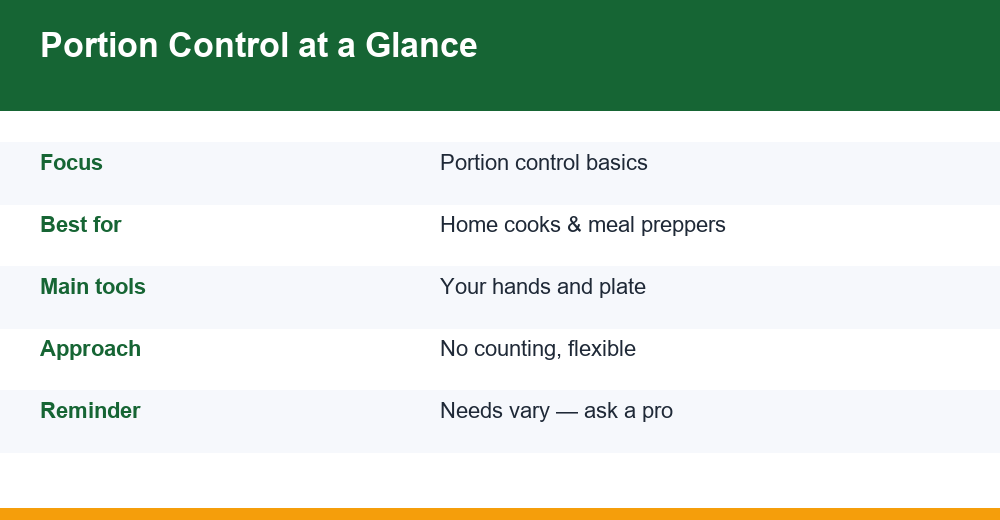
Because everyone’s needs differ by age, activity, and health, treat everything here as friendly guidance, not rules. If you have specific medical or dietary needs, or any allergies, a doctor or registered dietitian can tailor advice to you.
The Hand Method: Your Built-In Ruler
Your hands travel everywhere your meals do, which makes them a handy, always-available guide. Larger people tend to have larger hands and larger appetites, so the measurements scale naturally to your own body.
- Palm = a protein portion, such as chicken, fish, tofu, or beans
- Fist = a serving of cooked grains, pasta, or starchy vegetables
- Cupped hand = a portion of nuts, dried fruit, or cooked rice
- Thumb = a serving of cheese, nut butter, or oils
- Fingertip = a small amount of butter or spreads
Put it together and a plate becomes a palm of protein, a fist or two of vegetables, a cupped hand of grains, and a thumb of fat. That’s a balanced meal built in seconds without a single measuring cup.
Hands aren’t perfect. They don’t capture the calorie differences between, say, oily fish and lean chicken, and very active people may need more than the basic template suggests. Use them as a quick starting point, then adjust based on your energy, appetite, and how the last meal left you feeling.
One quiet advantage of the hand method is consistency. Your hands come with you to a friend’s kitchen, a work canteen, or a holiday buffet, where cups and scales are nowhere to be found. That portability makes it easy to keep the same rough proportions wherever you happen to be eating.
The Plate Method for Balanced Meals
If hands feel fiddly, let your plate do the work. The plate method turns a standard nine-inch dish into a simple visual template that keeps meals varied and satisfying.
- Fill half your plate with non-starchy vegetables or salad.
- Fill one quarter with protein like fish, poultry, eggs, beans, or lentils.
- Fill the last quarter with whole grains or starchy foods such as rice, potatoes, or wholemeal pasta.
Add a small amount of healthy fat, a piece of fruit, or a glass of water to round things out. This layout naturally nudges you toward a balanced diet without any math, and it flexes to fit almost any cuisine.
A weeknight version might be baked salmon, a generous pile of roasted broccoli and peppers, and a scoop of brown rice with a drizzle of olive oil. Swap the salmon for chickpeas and the rice for couscous, and the same proportions still hold.
Breakfast can follow the same logic in miniature. Picture a bowl with a scoop of porridge or a couple of eggs for protein, a handful of berries or sliced fruit, and a spoon of nuts or seeds for a little healthy fat. The proportions bend, but the balance stays familiar.
This flexibility is what makes the plate method last. A stir-fry, a curry with rice, a taco night, or a Sunday roast can all fit the same rough split of vegetables, protein, and starch. You’re not adopting a new cuisine, just adjusting the balance of what’s already on the table.
Smaller plates help too. The same food looks more generous on a nine-inch plate than on a wide platter, which can make a modest amount feel like plenty.
Common Portion Sizes at a Glance
Everyday objects make surprisingly good rulers. Keep a few of these mental pictures handy and you’ll rarely need to guess. This is where casual portion control quietly becomes second nature.
| Food | One portion | Looks like |
|---|---|---|
| Cooked meat or fish | Palm-sized piece | A deck of cards |
| Cooked rice or pasta | About a fist | A tennis ball |
| Cheese | A thumb | Two dice |
| Nuts or seeds | A cupped handful | A golf ball |
| Oil or butter | A fingertip | A postage stamp |
| Fresh fruit | One cupped hand | A tennis ball |
These are starting points, not strict limits. An active teenager and a sedentary adult have very different needs, so scale up or down to match your appetite and how you feel afterwards.
It helps to remember that these comparisons are about building a feel, not hitting a target. Once your eye is trained you can trust it and stop thinking about it, which is exactly the point. The goal is quiet confidence, not constant measuring.
Try measuring a few of your usual foods once with cups or a scale, then notice what that amount looks like on your own plates and in your own hands. After a couple of goes, the visual sticks and you can retire the measuring tools for everyday meals.
Don’t Forget Drinks and Extras
It’s easy to build a careful plate and then overlook everything poured into a glass or added on the side. Drinks, sauces, dressings, and spreads can quietly become a meal of their own, so they deserve the same friendly attention as the food itself.
| Drink or extra | Rough portion | Handy picture |
|---|---|---|
| Juice or smoothie | A small glass | Around 150ml |
| Milk or plant milk | A cupped hand | Roughly a small cup |
| Salad dressing | A thumb | A spoon or two |
| Spread or nut butter | A thumb tip | A level spoon |
| Fizzy or sugary drinks | An occasional treat | Not an everyday default |
Water is the easy win here, since it fills you up without competing with your meal. If you enjoy other drinks, that’s completely fine; simply noticing roughly how much you’re having is enough to keep the balance you built on your plate.
Common Portion Pitfalls to Watch
A few familiar situations tend to nudge portions upward without us noticing. Spotting them ahead of time is half the battle, and it keeps portion control feeling effortless rather than like a constant fight.
- Eating straight from the packet, tub, or pan, where there’s no natural stopping point.
- Second helpings taken on impulse before the first plate has had time to settle.
- Calorie-dense favourites like oils, cheese, and nuts, which are lovely but easy to overdo.
- Grazing while tired, stressed, or distracted, when it’s hard to register what you’ve eaten.
- Super-sized packaging and ‘meal deal’ upgrades that make a bigger amount feel like the norm.
None of these foods or habits are villains. The aim is simply awareness, so you can keep enjoying the things you love while gently keeping an eye on how much lands on your plate.
Mindful Eating and Your Hunger Cues
Even well-judged portions fall flat if you eat on autopilot. Mindful eating simply means paying attention to your food and your body while you eat, instead of finishing a plate before you’ve noticed it was in front of you.
Fullness signals take a little while to reach your brain, so eating slowly gives them time to catch up. Put your fork down between bites, chew properly, and check in with yourself around the halfway mark to see how hungry you still are.
It also helps to pause before going back for more. A short gap, even just a few minutes, gives your body time to tell you whether you’re genuinely still hungry or simply enjoying the taste. More often than not, a glass of water and a little patience settle the question.
- Eat when you’re genuinely hungry, not just bored, tired, or stressed.
- Aim to stop at comfortably satisfied rather than completely full.
- Notice the difference between real hunger and a craving for a particular taste.
- Cut distractions like screens, which make it easy to overeat without noticing.
Food is also comfort, celebration, and connection, and that’s perfectly healthy too. Mindful eating isn’t about policing every bite; it’s about noticing when you’re eating for reasons other than hunger, so you can choose freely rather than automatically. There’s no such thing as a ‘bad’ food to feel guilty about.
Learning to read these hunger cues is one of the most reliable skills you can build. Over time, your own body becomes a better guide than any chart or app.
Portions When Eating Out and Snacking
Restaurants and takeaways are famous for generous servings, which can quietly reset what looks ‘normal’ back home. The good news is you don’t need to avoid them at all.
A few small habits keep things comfortable. Practising portion control when eating out is mostly about planning ahead and slowing down, not going without.
- Box up half a large main before you start, or split a dish with someone.
- Order a starter as your main, or a main to share alongside a side salad.
- Ask for dressings and sauces on the side so you decide how much goes on.
- Keep an eye on drinks and sides, which often add up faster than the meal itself.
Buffets deserve a special mention, since endless choice makes it easy to lose track. A gentle trick is to take a slow walk past everything first, then choose a plateful of the dishes you truly fancy rather than a little of every single one.
The same idea works for snacks. Tip crisps or nuts into a small bowl instead of grazing straight from the bag, so you can actually see the amount and enjoy it properly.
Making Portion Awareness Stick
The goal isn’t a rigid system you dread; it’s a handful of easy defaults that fade into the background. Sustainable portion control should feel lighter over time, not heavier.
Meal prep helps enormously. When you divide food into containers in advance, the decision is already made for you when hunger and tiredness hit at the same time.
- Cook once and split meals into single-serve containers for the week.
- Use smaller plates, bowls, and glasses at home as your everyday default.
- Keep tempting extras out of easy reach and healthy options visible.
- Serve from the stove rather than bringing serving dishes to the table.
Pair these with your wider healthy eating habits and they reinforce one another. For a deeper look at recommended amounts, the NHS guide to food portion sizes is a trustworthy, evidence-based reference.
Measure your progress by how you feel, not by numbers on a page. Steady energy, comfortable meals, and less fuss around food are the real signs that portion control has settled into a habit rather than a chore.
Consistency matters more than intensity. A relaxed approach you can keep up for years will always beat a strict regime you abandon in a fortnight.
Above all, be patient and kind with yourself. No single meal makes or breaks your health, and steady progress beats perfection every time.
Frequently Asked Questions
Do I need to weigh my food to control portions?
No. A food scale can be a useful learning tool for a week or two, but everyday portions are easy to judge with your hands, your plate, and familiar objects like a deck of cards. Most people do perfectly well without weighing anything at all.
Is portion control the same as dieting?
Not really. Dieting usually means cutting foods out or following strict rules. Portion awareness is about how much you eat, not what, so nothing is off-limits. It’s a flexible, long-term habit rather than a short-term plan, which is exactly why it tends to last.
How can I stop overeating in the evening?
Evening grazing often comes from skimping earlier in the day, so eat balanced meals with enough protein and fibre. Plate your snack instead of eating from the packet, sip some water, and give yourself a few minutes before a second helping to check if you’re truly still hungry.
Are hand portion sizes accurate for everyone?
They’re a helpful guide rather than a precise measure. Because hand size roughly tracks body size, portions scale to the person. Needs still vary with age, activity, and health, so adjust to your appetite and speak to a dietitian for advice tailored to you.