Healthy fats have shaken off their old reputation as something to avoid, and for good reason. The right fats help your body absorb certain vitamins, keep you satisfied after meals, and support your heart and brain. The real skill lies in knowing which fats to lean into, which to keep to smaller amounts, and how to fit them comfortably into everyday cooking. This guide breaks it all down in plain, friendly language, with real food and simple swaps you can start using today, whatever your kitchen confidence.
Table of Contents
What Are Healthy Fats, Really?
Fat is one of the three main macronutrients, sitting alongside protein and carbohydrates. Far from being the enemy, it does jobs nothing else can: it carries the fat-soluble vitamins A, D, E and K around your body, helps build cell membranes, cushions your organs, and gives food much of its flavour and staying power. A meal with a little fat simply tastes better and tends to keep hunger at bay for longer.
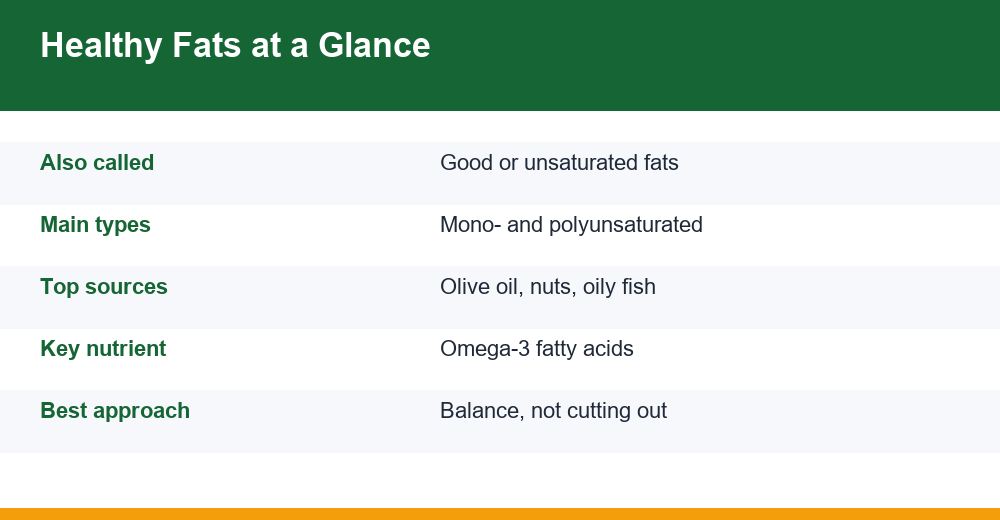
So what makes some fats better than others? It largely comes down to their chemical structure and how they behave inside the body. Healthy fats are mainly the unsaturated kind found in plants and fish, and they are associated with better heart and cholesterol outcomes when they replace less helpful fats in the diet. The fats worth limiting are those that tend to nudge cholesterol in a less favourable direction over time.
The reassuring part is that you do not need to memorise chemistry or count grams to eat well. Once you recognise the handful of foods that deliver the most beneficial fats, plus a few you might gently dial back, the rest tends to fall into place on its own.
It also helps to think in terms of everyday patterns rather than single meals. One buttery breakfast or a bag of crisps will not undo your efforts, just as a single salad will not transform your health. What counts is the steady rhythm of your choices across weeks and months, and fats are simply one thread woven through the bigger picture of how you eat.
The Four Main Types of Dietary Fat
Nutrition labels tend to lump everything under one word, fat, yet there are really four categories worth understanding. Two are generally helpful, one is perfectly fine in moderation, and one is best kept to a minimum.
Monounsaturated fats
These are the gentle, friendly fats found in olive oil, avocado and most nuts. They form a cornerstone of the Mediterranean style of eating and are associated with a healthier cholesterol balance. They stay liquid at room temperature but thicken slightly in the fridge, which is a handy way to recognise them at a glance.
Polyunsaturated fats
This group includes the omega-3 and omega-6 fatty acids that your body cannot manufacture on its own, so they have to come from food. You will find them in oily fish, walnuts, flaxseed, sunflower seeds and soybeans. Because they support heart and brain function and cannot be made internally, they are considered essential parts of the diet.
Saturated fats
Found in butter, cheese, fattier cuts of meat, coconut and palm oil, saturated fats are solid at room temperature. Current general guidance suggests keeping them to a modest share of your day rather than removing them altogether. There is still room for a knob of butter or a slice of good cheese within a varied diet; it is the overall pattern that matters most.
Trans fats
These are the ones genuinely worth minimising. Artificial trans fats, created by hydrogenating oils, were once common in fried and packaged foods and are strongly linked with heart disease. Many countries have restricted them, yet they can still appear in some processed baked goods, so it is worth checking labels for partially hydrogenated oils. For a detailed, evidence-based breakdown of each type, the Harvard T.H. Chan School of Public Health Nutrition Source is a reliable reference.
Seeing fats on a spectrum, rather than as simply good or bad, takes a lot of pressure out of everyday choices. Most whole foods contain a natural mix of these types anyway, so the goal is a helpful overall balance rather than perfection with any single item.
- Favour: monounsaturated and polyunsaturated fats from plants and fish
- Enjoy in moderation: saturated fats from dairy, meat and tropical oils
- Minimise: artificial trans fats from partially hydrogenated oils
Where to Find the Good Fats
The easiest way to build in more healthy fats is to keep a few reliable ingredients within easy reach. Most are versatile, store well, and slip into meals you already make without much fuss. The table below offers a quick reference to some of the best everyday sources, along with a simple way to enjoy each one.
| Food | Main fat type | Easy way to enjoy it |
|---|---|---|
| Extra-virgin olive oil | Monounsaturated | Drizzle over salads or roasted vegetables |
| Avocado | Monounsaturated | Mash onto toast or add to salads |
| Almonds and walnuts | Mono- and polyunsaturated | A small handful as a snack |
| Chia and flaxseed | Polyunsaturated (omega-3) | Stir into oats or yoghurt |
| Salmon, mackerel, sardines | Polyunsaturated (omega-3) | Grill, bake or use tinned |
| Tahini and nut butters | Mono- and polyunsaturated | Spread, or blend into dressings |
| Olives | Monounsaturated | Toss through pasta or grain bowls |
Notice how many of these double as a source of protein too. Nuts, seeds, tofu and edamame all bring good fats alongside a useful protein contribution, which is exactly why they feature so often in plant-based protein meals. Building a snack or lunch around them means you quietly cover two bases at once, with a helpful dose of fibre thrown in for good measure.
If you are shopping on a budget, rest assured that good fats need not be expensive. Tinned oily fish, own-brand nuts and seeds, a standard bottle of olive oil and a bag of frozen edamame all deliver plenty without straining the weekly shop. Buying nuts and seeds in larger bags and storing them well often works out cheaper still.
Variety tends to matter far more than any single so-called superfood. Rotating through different nuts, seeds, oils and types of fish across a week gives you a broader spread of nutrients than leaning on the same one ingredient every single day.
Omega-3s: The Fats Worth Prioritising
Among the polyunsaturated fats, omega-3s deserve a special mention. They come in three main forms: EPA and DHA, found mostly in oily fish, and ALA, found in plant foods such as flaxseed, chia and walnuts. Your body can convert a little ALA into EPA and DHA, though not very efficiently, which is why eating fish or another direct source is genuinely helpful.
Omega-3s are associated with heart health and normal brain function, and they are one of the more common gaps in a typical Western diet. As a general habit, many health guidelines mention enjoying oily fish a couple of times a week, whether that is a salmon fillet, a tin of sardines on toast, or some mackerel stirred through a grain bowl.
Interest in omega-3s has grown partly because modern diets often tip heavily towards omega-6, found in many vegetable oils and processed foods. You do not need to fear omega-6, which is essential too, but gently nudging more omega-3 sources onto your plate helps keep the two in a more comfortable balance.
If you eat little or no fish, there is no need to worry. Ground flaxseed, chia, walnuts and rapeseed, or canola, oil all supply plant-based omega-3s. Grinding flaxseed rather than eating it whole makes the fats far easier for your body to reach. Supplements are available too, though a food-first approach tends to be a sensible starting point for most people.
- Marine sources (EPA and DHA): salmon, mackerel, sardines, herring, trout
- Plant sources (ALA): ground flaxseed, chia seeds, walnuts, rapeseed oil
- A simple habit: include oily fish a couple of times a week if you eat it
Cooking With Fats Without the Guesswork
Choosing a good fat is only half the story; using it well is the other half. Every oil has a smoke point, the temperature at which it begins to break down, smoke and taste bitter. Matching the oil to the task keeps flavour intact, protects the more delicate nutrients, and helps you avoid unnecessary waste.
| Oil or fat | Best used for | Good to know |
|---|---|---|
| Extra-virgin olive oil | Dressings, low-medium heat | Lovely raw; fine for everyday sauteing |
| Light or refined olive oil | Roasting, frying | Higher smoke point, milder taste |
| Rapeseed (canola) oil | All-round cooking | Neutral flavour, some omega-3 |
| Avocado oil | High-heat searing | Very high smoke point |
| Butter | Finishing, low heat | Browns fast; add near the end |
| Nut and seed oils | Drizzling, dressings | Delicate; keep off high heat |
A few small habits keep your fats fresh and useful. Store oils away from light and heat rather than beside the hob, and try to use nuts and seeds within a few months, since their delicate fats can turn stale, or rancid, over time. Keeping ground flaxseed and nut oils in the fridge extends their life considerably.
You also do not need to drown food in oil to reap the benefit. A single tablespoon to roast a whole tray of vegetables, or a light drizzle to finish a bowl of soup, adds real flavour and nutrients without overdoing things or overwhelming the dish.
Portion Awareness, Not Portion Anxiety
Here is the honest part: even the best fats are energy-dense, so portions are worth a gentle bit of attention. That does not mean weighing out every almond or feeling guilty about a drizzle of olive oil. It simply means letting fats play a supporting role on the plate rather than taking over the entire meal.
A useful mental picture helps. A thumb-sized amount of oil or nut butter, or a small cupped handful of nuts, makes a sensible everyday serving for most people. Beyond that, you can usually trust your appetite. Because healthy fats are so satisfying, they naturally help you feel comfortably full, which often does much of the regulating for you.
Fats work best as one piece of a bigger picture, sitting comfortably alongside plenty of vegetables, whole grains, protein and fibre. If you would like to see how everything fits together, our guide to building a balanced diet places fats in context with the rest of what lands on your plate.
There is no single right number that suits everybody. Activity levels, appetite, life stage and individual needs all vary from person to person, so it makes sense to aim for a comfortable pattern you can genuinely keep up rather than a rigid rule that feels like a chore.
Easy Ways to Eat More Good Fats
You do not need a dramatic diet overhaul to enjoy more good fats, just a handful of small, repeatable swaps that quietly upgrade the meals you already eat. Try weaving a few of these into your usual week and see which ones stick.
- Swap a splash of your usual cooking oil for extra-virgin olive oil in dressings and low-heat cooking.
- Add half an avocado to toast, salads or a wrap in place of a creamy spread.
- Keep a jar of mixed nuts and seeds to sprinkle over porridge, yoghurt or salads.
- Put oily fish on the menu once or twice a week; tinned counts and is budget-friendly.
- Stir a spoon of ground flaxseed or chia into oats, smoothies or baking.
- Whisk tahini or nut butter into dressings and sauces for extra richness and depth.
The aim is not perfection or a total rethink of the way you eat. It is steady, enjoyable habits that make good fats a natural part of tasty, satisfying food. Choose one or two swaps to begin with, notice how much more filling your meals feel, and simply build from there at your own pace.
Finally, a gentle but important note: this article offers general information, not personal advice. If you have a medical condition, a food allergy, or specific dietary needs, it is always worth checking with a doctor or a registered dietitian, who can tailor recommendations to your individual circumstances.
Frequently Asked Questions
Do healthy fats keep you fuller for longer?
Often, yes. Fats are energy-dense yet genuinely satisfying, so a modest amount alongside protein and fibre can help meals feel more filling and steady. The focus is on portion awareness and an overall varied diet rather than cutting fats out. For needs specific to you, a registered dietitian can offer tailored guidance.
Is olive oil still healthy for cooking?
Yes. Extra-virgin olive oil is well suited to everyday low-to-medium-heat cooking and lovely used raw in dressings. For high-heat searing, a refined olive oil, avocado oil or rapeseed oil copes better with the temperature while holding on to its flavour.
Do I need supplements to get enough omega-3?
Most people can meet their needs through food, especially with oily fish a couple of times a week plus plant sources such as flaxseed and walnuts. If you eat no fish or have particular requirements, ask a doctor or dietitian whether a supplement would suit you.
Are saturated fats really bad for you?
Not off-limits, but worth moderating. Foods like butter and cheese can fit into a varied diet in reasonable amounts. General guidance suggests keeping saturated fat to a modest share of the day and favouring unsaturated fats where you can, with the overall pattern mattering most.