Learning how to store food well is one of the quietest wins in any kitchen: it keeps meals safe, cuts waste, and saves money without asking much of you. This guide walks through fridge and freezer temperatures, realistic storage times, smart containers, and the cooling and refreezing rules that actually matter. Get these basics right and how to store food stops being a worry and becomes second nature.
Table of Contents
Why Safe Food Storage Matters
Good storage is where healthy eating quietly succeeds or falls apart. When ingredients stay fresh, you actually cook them instead of tossing them, and the meals you prepped on Sunday still look appetising on Wednesday. Poor storage does the opposite: it wilts greens, spoils leftovers, and occasionally makes people ill.
The stakes come down to bacteria. Harmful microbes multiply fastest in the danger zone between roughly 8°C and 63°C (about 46°F to 145°F), so every tip below has one aim, to keep food out of that range. Understanding how to store food properly is really just learning to keep things cold, covered, and used in good time.
- Less waste: fresh food gets eaten, not binned.
- Lower risk: cold temperatures slow the bacteria behind food poisoning.
- Better flavour: proper wrapping prevents drying, freezer burn, and fridge odours.
- Real savings: buying in bulk only pays off if the food survives the week.
None of this needs special equipment or fussy rules. A reliable fridge, a few good containers, and a little routine cover almost everything. Think of storage as the last, easy step of cooking rather than a separate chore, and the payoff shows up as tastier meals, a calmer kitchen, and less money quietly going in the bin each week.
Fridge and Freezer Temperatures That Keep Food Safe
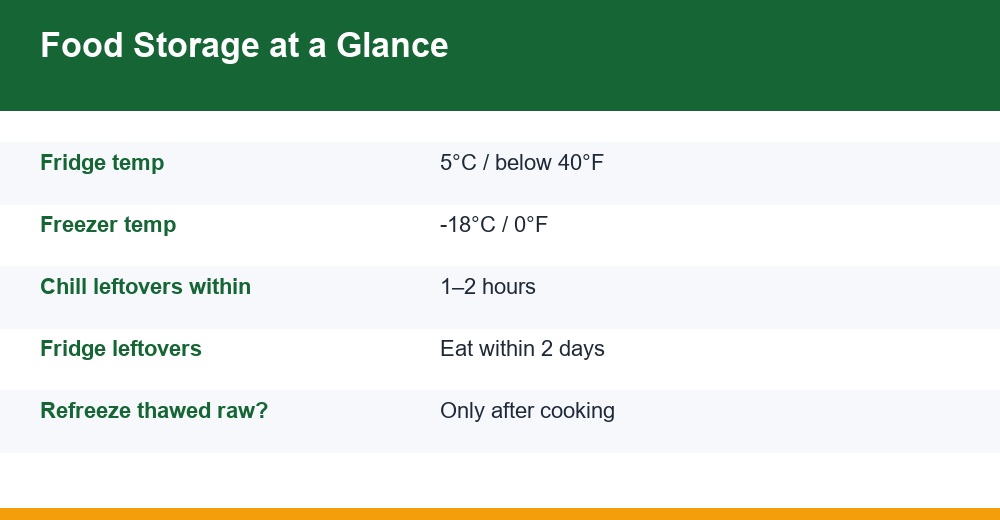
Your fridge should sit at or below 5°C (about 40°F), and your freezer at -18°C (0°F). Most fridges have a vague dial rather than a clear number, so a cheap fridge thermometer is one of the best few pounds you can spend. Check it now and then, especially in summer or after a big shop.
Temperature is not even throughout the fridge, and that changes where things belong. The back and bottom shelves run coldest, while the door is the warmest spot of all.
- Top shelves: ready-to-eat foods, leftovers, dairy, and drinks.
- Middle shelves: eggs, cheese, and cooked items in sealed containers.
- Bottom shelf: raw meat, poultry, and fish, wrapped and on a plate so juices cannot drip.
- Salad drawer: fruit and vegetables, ideally in their own bags or crispers.
- Door: the warmest zone, best for condiments, juices, and jams, not milk or eggs.
Try not to overfill either appliance. Air needs room to circulate to hold an even temperature, and a fridge crammed to the door often runs warmer than the dial suggests. A freezer, by contrast, works happily when fairly full.
Power cuts and holidays call for a plan too. A full freezer holds its cold for roughly 24 to 48 hours if you keep the door firmly shut, so resist the urge to peek. If food has fully thawed and stayed above 5°C for more than a couple of hours, it is safer to throw it out than to gamble on it.
How to Store Food by Type
Different foods want different treatment, and a little sorting goes a long way. Knowing how to store food by category means fewer soggy salads and firmer ingredients that genuinely last.
Fruit and vegetables
Keep most vegetables in the salad drawer, loosely bagged so they can breathe. Leafy greens like a touch of moisture, while mushrooms prefer paper over plastic. Store potatoes, onions, and garlic in a cool, dark cupboard rather than the fridge. Leave bananas, tomatoes, and unripe stone fruit on the counter, and chill them only once fully ripe.
Meat, fish, and dairy
Always keep raw meat, poultry, and fish on the bottom shelf in sealed containers so nothing drips onto ready-to-eat food. Use or freeze them within a day or two of buying. Milk and eggs belong on a cold inner shelf, not the door, where the temperature swings every time you open it.
Bread, herbs, and leftovers
Bread stales fastest in the fridge, so keep it in a bin or bag at room temperature and freeze any extra in slices. Fresh herbs last longest trimmed and stood in a little water like a small bouquet, loosely covered. Cooked leftovers should be cooled, sealed, and refrigerated promptly, then eaten within a day or two so nothing lingers past its best.
Pantry staples
Dry goods such as rice, pasta, flour, and pulses keep best in airtight jars away from heat and light. Once opened, oils, nuts, and wholegrain flours turn rancid faster, so buy them in amounts you will realistically finish. If you are building a routine, our guide to meal prep for beginners pairs neatly with a tidy, well-labelled pantry.
Storage Times for Common Foods
Storage times cover safety and quality together. Fridge limits protect you from bacteria, while freezer limits are mostly about taste and texture, since food kept steadily at -18°C stays safe far longer than it stays delicious. Treat the chart below as a friendly rule of thumb rather than a stopwatch, and when in doubt, throw it out.
| Food | Fridge (5°C / 40°F) | Freezer (-18°C / 0°F) |
|---|---|---|
| Raw mince, poultry, fish | 1–2 days | 3–4 months |
| Raw beef, pork, lamb cuts | 3–5 days | 6–12 months |
| Cooked leftovers | Up to 2 days | 2–3 months |
| Soups and stews | 2–3 days | 2–3 months |
| Eggs (in shell) | 3–5 weeks | Freeze out of shell |
| Hard cheese | 3–4 weeks | Up to 6 months |
| Cooked rice (cooled fast) | 1 day | About 1 month |
| Milk (opened) | By use-by date | About 1 month |
Advice varies a little by country. UK guidance suggests eating most cooked leftovers within two days, while some US charts allow three to four. When sources differ, following the shorter time is the safe habit.
Dates on packaging help, but they mean different things. A use-by date is about safety and should be respected, while a best-before date is about quality, so many foods are perfectly fine a little past it. Follow use-by dates strictly, and lean on your eyes and nose for best-before ones.
Airtight Containers and Labelling
The right container does half the work. Airtight boxes keep moisture in, odours out, and pests away, and clear ones let you see what needs eating first. A mix of sizes, plus a few freezer-safe bags, covers almost everything a home kitchen throws at it.
- Choose glass or sturdy, BPA-free plastic with a tight-fitting seal.
- Cool food before sealing so condensation does not pool inside.
- Freeze in portion sizes you will actually use in one go.
- Leave a little headroom in liquids, since they expand as they freeze.
Give containers a proper wash and dry between uses, since trapped moisture and old residue shorten how long fresh food lasts. Match the box to the job too: shallow ones cool food faster, tall ones save shelf space, and rigid boxes protect delicate items in a busy freezer.
Labelling sounds fussy until the day you meet a mystery tub of orange something. A strip of masking tape and a marker is plenty: note what it is and the date you stored or froze it. This tiny habit is a big part of how to store food without waste, and it makes rotating your fridge effortless.
If you cook in batches, clear labels turn a crowded freezer into a menu you can shop from at home. Browse our meal prep ideas for dishes that freeze and reheat especially well.
Cooling Cooked Food the Safe Way
Hot food left on the counter is an open invitation to bacteria, but a steaming pot placed straight into the fridge warms everything around it. The fix is to cool quickly, then chill. Aim to get cooked food into the fridge within one to two hours.
- Divide big batches into shallow, smaller containers.
- Sit a hot pan in a sink of cold or iced water, stirring now and then.
- Spread rice or grains on a tray so they lose heat fast.
- Slice large joints of meat rather than chilling them whole.
Speed matters most with rice, which can carry spores that survive cooking. Cool it within an hour, refrigerate it promptly, and reheat it only once until piping hot. For the full official picture on chilling, freezing, and defrosting, the UK’s Food Standards Agency is a clear, trustworthy reference.
Reheating deserves the same care as cooling. Warm leftovers right through until steaming hot at the centre, not just around the edges, and reheat any given portion only once. Stir halfway when using a microwave, since it heats unevenly, and avoid keeping food lukewarm for hours on a low hob or hotplate.
What You Should Never Refreeze
Refreezing is where good intentions often go wrong. Each thaw gives bacteria a fresh window to multiply, and remember that freezing pauses microbes rather than killing them. A few clear rules keep you on the safe side.
- Do not refreeze raw meat or fish that has thawed, unless you cook it first, then you can freeze the cooked dish.
- You can refreeze cooked meat and fish once, as long as it was cooled before freezing.
- Food thawed in the fridge is safest; food thawed on the counter should be used, not refrozen.
- Never refreeze anything that has sat warm for more than two hours.
Some foods, like ice cream and delicate sauces, suffer in texture even when technically safe, so trust your senses. If something smells off, looks slimy, or its packaging has bloated, let it go. No meal is worth a stomach bug.
Planning ahead makes refreezing rarely necessary. Freeze food in single-meal portions from the start, and defrost only what you will use. Move items from freezer to fridge the night before, which keeps them out of the danger zone while they thaw. A little forethought means you almost never face the refreeze question at all.
Spotting Food That Has Gone Off
Even with careful storage, food does not last forever, and your senses are the best final check. Look, smell, and where sensible gently touch before you eat. Trust these signals over optimism, because taste-testing something questionable is never worth the risk.
- Smell: sour, sharp, or off odours are a clear stop sign, especially in dairy, meat, and fish.
- Look: mould, sliminess, a dull colour, or cloudy liquid all suggest it is time to bin it.
- Texture: sticky meat, mushy vegetables, or a fizzy feel in something that should be still.
- Packaging: bloated tins, blown lids, or leaking pouches mean the contents are unsafe.
One caution: some harmful bacteria leave no smell, taste, or visible sign at all. That is exactly why the storage times, temperatures, and cooling steps above matter so much. Use your senses as a backstop, not as your only line of defence, and follow the timings whenever you are unsure.
Simple Habits That Make It Stick
The real secret to how to store food is turning it into routine, so you barely think about it. None of this needs a spreadsheet, just a handful of small moves repeated often enough to become automatic.
- Do a weekly fridge sweep and move older items to the front to eat first.
- Store raw meat low and ready-to-eat food high, every single time.
- Cool, cover, and label leftovers before they leave the kitchen.
- Keep a running note of what is in the freezer so nothing gets lost.
- Trust dates and your nose together, and clear out anything past its best.
Everyone’s kitchen and needs are different, and this is general guidance rather than personal advice. If you are managing a food allergy, a medical condition, or a specific dietary requirement, check with your doctor or a registered dietitian. Get the basics steady, though, and safe, fresh, low-waste food quietly becomes your default.
Frequently Asked Questions
What is the ideal fridge temperature?
Keep your fridge at or below 5°C, which is about 40°F, to slow the bacteria that cause food poisoning. A small fridge thermometer helps, since built-in dials are often vague. Check it during warm weather and after a big shop, when the fridge has to work hardest.
How long do leftovers last in the fridge?
Most cooked leftovers are best eaten within two days in the UK, though some US guidance allows three to four. Cool them quickly, keep them covered, and reheat only once until piping hot. If you are unsure how old something is, it is safer to throw it out.
Can I refreeze food that has thawed?
You should not refreeze raw meat or fish that has defrosted unless you cook it first, after which the cooked dish can be frozen. Cooked meals can be refrozen once if they were cooled before freezing. Food thawed at room temperature should be used rather than refrozen.
How quickly should I cool cooked food?
Aim to get cooked food into the fridge within one to two hours. Speed up cooling by dividing large batches into shallow containers or sitting the pan in cold water. Rice matters most, so cool it within an hour and reheat it only once until piping hot.